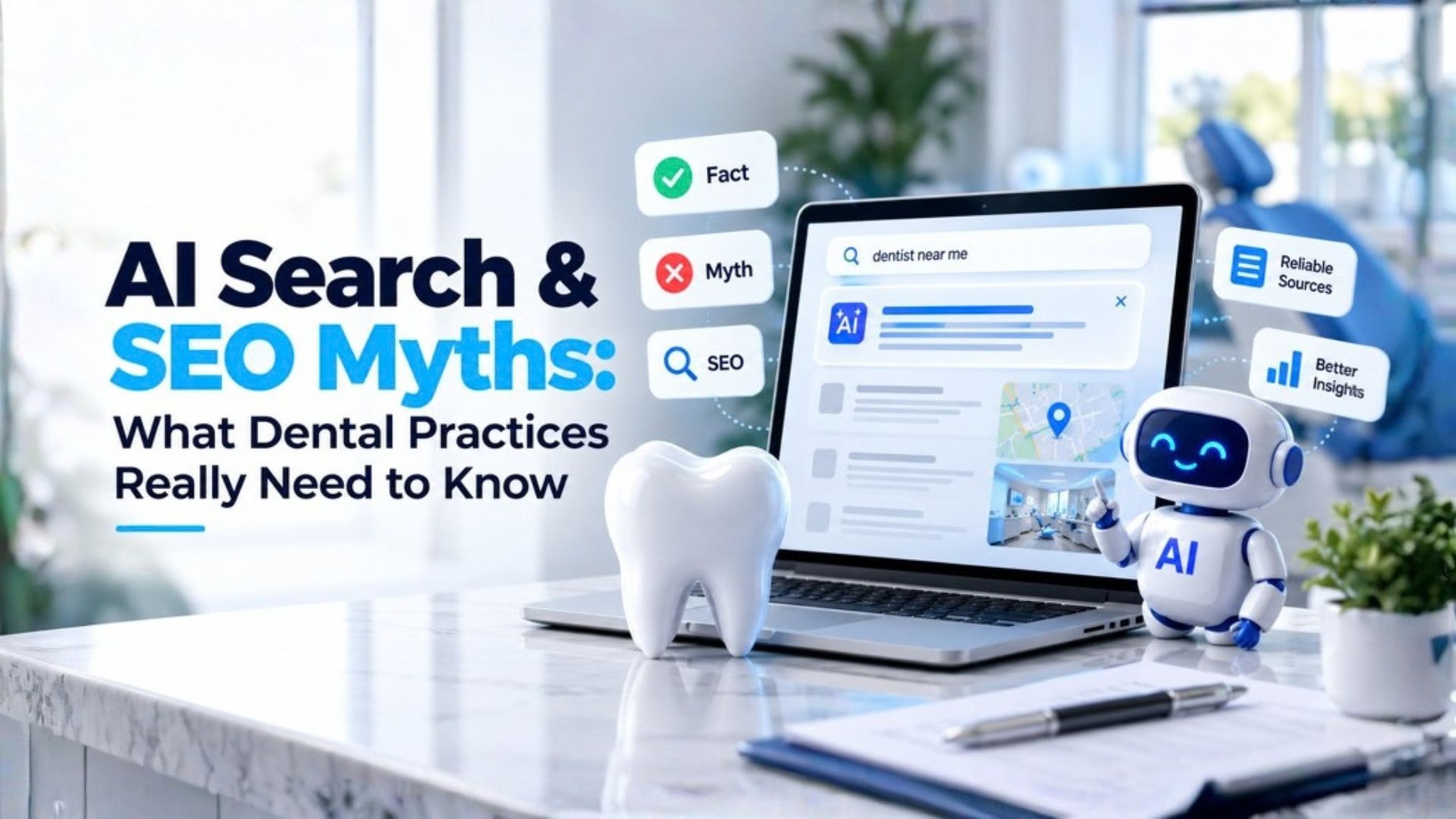
Artificial intelligence is changing how people discover information online. Patients can now ask AI tools questions about dental treatments, compare providers, research symptoms, and explore their options before ever visiting a dental website.
With that shift has come a wave of predictions about the future of SEO. Some marketers claim traditional search is disappearing, others say AI-generated content cannot rank, and some believe organic traffic is no longer worth pursuing.
The reality is more nuanced.
Here are some of the biggest AI-search and SEO assumptions dental practices should look at more carefully.
Myth 1: AI Is Replacing Traditional Search
The rise of AI search doesn’t mean traditional search is disappearing. Traditional SEO continues to grow and remains an important way for businesses to reach potential customers.
People still use Google to find dentists, compare services, check reviews, research treatments, find directions, and visit practice websites. At the same time, AI tools are becoming another part of the discovery journey.
For a dental practice, the opportunity isn’t necessarily to choose between Google and AI. It is to build a strong digital presence that can support patients across multiple discovery channels.
That includes Dental SEO, local search, helpful website content, reviews, social media, and a well-optimized Google Business Profile.
Myth 2: Zero-Click Search Means SEO Doesn’t Work Anymore
AI Overviews and other search features can provide answers directly within search results, reducing the need for some users to click through to a website.
But that doesn’t mean every search has become zero-click.
Patients still need websites when they want to learn about a specific procedure, understand a practice’s services, view credentials, read patient information, request an appointment, or contact the office.
For dental practices, this makes the quality of the website increasingly important. Ranking isn’t simply about generating impressions. Your website needs to give visitors a reason to continue the journey.
A strong Dental SEO strategy should therefore focus on visibility, relevance, useful content, and the experience that follows the search.
Myth 3: AI-Generated Content Can’t Rank
Another common assumption is that anything written with AI will automatically be ignored by search engines.
That’s an oversimplification.
The more important question is whether the content is useful, accurate, original, and created to help people. Google specifically advises publishers to focus on people-first content and warns against using automation primarily to manipulate search rankings.
For dental websites, this distinction matters.
AI can help with research, brainstorming, outlines, and initial drafts. But dental content still needs human oversight, factual review, appropriate expertise, and information that reflects the practice and its patients.
The goal shouldn’t be to publish hundreds of AI-written pages.
The goal should be to create content patients would actually want to read, trust, and use.
What This Means for Dental Marketing
AI search doesn’t make other marketing channels irrelevant. It makes having a connected digital strategy more important.
Dental SEO can help patients discover your practice through organic search.
Dental PPC can place your practice in front of people actively searching for specific treatments or services.
Dental Social Media can help build familiarity, demonstrate the personality of the practice, and keep your brand visible between appointments and searches.
And a Dental Consultant can help bring these channels together into a strategy based on the practice’s goals, market, competition, and available resources.
Instead of asking whether SEO, PPC, social media, or AI search is going to “win,” dental practices should consider how these channels work together.
Don’t Build Your Strategy Around the Latest AI Prediction
Search is changing quickly, which makes bold predictions easy to publish and difficult to rely on.
A better approach is to look at actual search behavior, website performance, patient journeys, conversions, and the questions prospective patients are asking.
Google’s current guidance continues to emphasize original, helpful, reliable information created primarily for people.
For dental practices, that means the fundamentals still matter: useful content, a technically sound website, strong local visibility, accurate information, genuine expertise, and a clear path for patients to take action.
AI is changing how people search.
It doesn’t eliminate the need to be visible, trustworthy, and useful.
The practices that adapt their digital marketing around real patient needs, not the latest SEO myth, will be better positioned to navigate whatever the next phase of search brings.
The Dental Marketer Approach
AI search is changing how patients discover dental practices, but strong Dental SEO and quality content remain important. Dental Marketer helps practices adapt to these changes with people-first Dental Marketing strategies focused on visibility, trust, and meaningful patient engagement.