
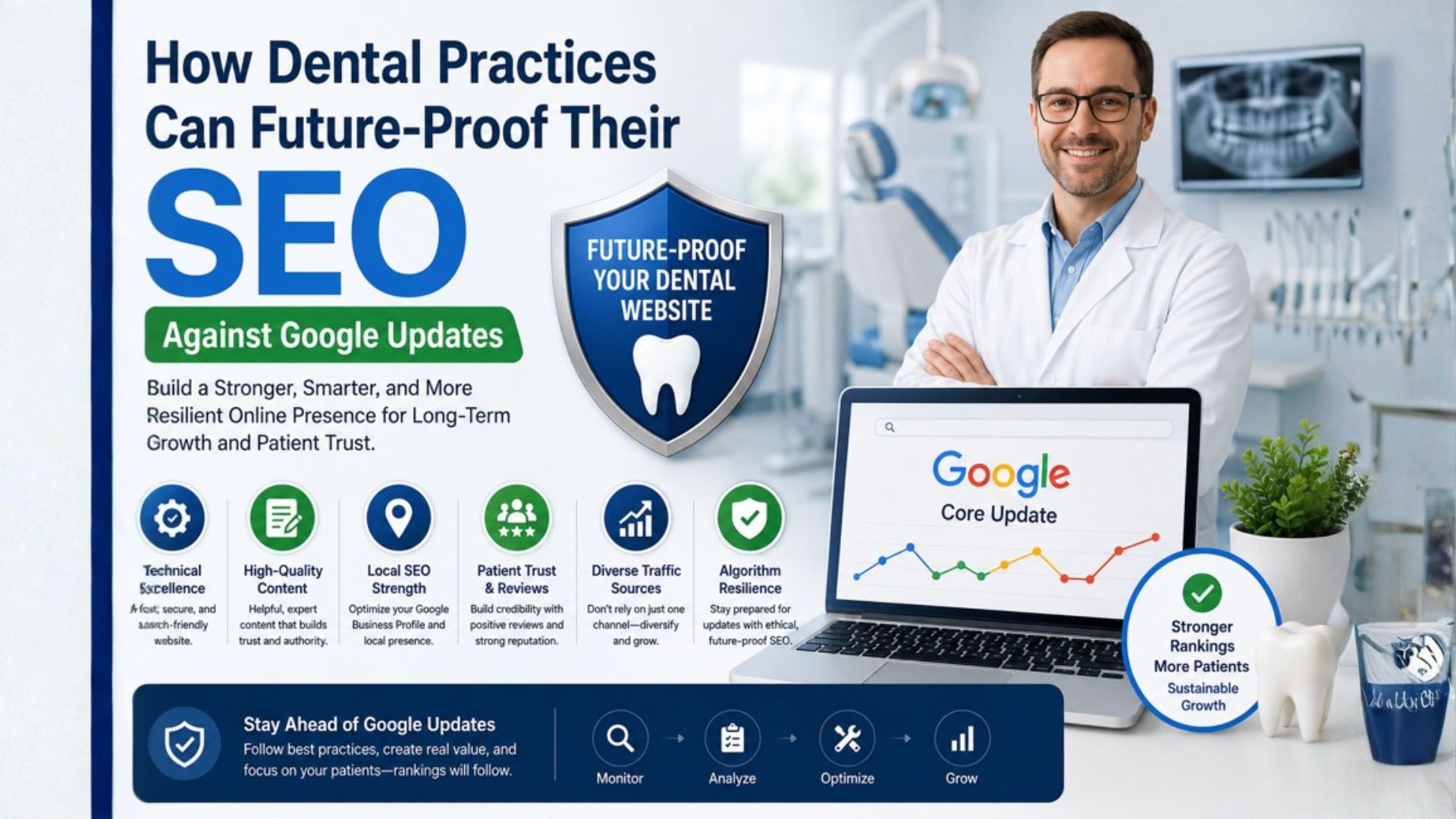
Google is constantly changing how it evaluates and displays websites. Core updates, spam updates, AI-powered search features, and changes in search behavior can all influence how dental practices appear online.
For dental practices, this creates an important question:
How can you build an SEO strategy that remains effective even when Google changes its algorithms?
The answer isn’t to predict Google’s next update. It is to build a strong, diversified digital presence that isn’t dependent on one keyword, one page, or one SEO tactic.
Why Dental SEO Rankings Can Change
Search rankings are not static. Your dental practice may maintain the same website while competitors improve their content, earn new links, enhance their user experience, or strengthen their local presence.
At the same time, Google continually improves its search systems and introduces new SERP features, including AI-powered experiences. These changes can alter which pages receive visibility and clicks.
Common reasons for ranking fluctuations include:
- Google algorithm updates
- Changes in search intent
- Competitor improvements
- Technical website issues
- Content quality problems
- Changes in local search results
- New AI search features
- Declining or changing backlinks
Instead of reacting to every fluctuation, dental practices should build an SEO strategy designed for long-term resilience.
1. Build a Strong Technical SEO Foundation
Technical SEO is the foundation of a future-proof dental website.
Search engines need to be able to crawl, render, and index your important pages. If technical problems prevent Google from accessing your content, even an excellent dental service page may struggle to perform.
Your technical SEO strategy should regularly check:
- Robots.txt
- XML sitemap
- Indexability
- Canonical tags
- Page speed
- Core Web Vitals
- Mobile usability
- Broken links
- Redirects
- HTTPS
- JavaScript rendering
- Structured data
Regular technical audits are preferable to waiting until traffic drops to discover a major issue. Search Engine Land similarly recommends routine technical checks as part of a resilient SEO strategy.
Read More: Technical SEO for AI Search
2. Don’t Build Your Strategy Around Keywords Alone
Keyword targeting remains important, but modern Dental SEO should go beyond repeating keywords throughout a page.
Google increasingly evaluates content based on meaning, relevance, context, and search intent.
For example, a dental practice shouldn’t create separate pages simply for:
- Dentist Toronto
- Toronto Dentist
- Dentist in Toronto
- Best Dentist Toronto
Instead, create a genuinely useful Toronto dental page that addresses the needs of patients searching for dental care in that market.
The same principle applies to treatment pages.
A strong dental implants page can naturally address related questions about candidacy, treatment options, recovery, maintenance, and costs without creating multiple thin pages.
3. Strengthen E-E-A-T and Dental Expertise
Dental content falls within a subject where accuracy and expertise matter.
Your website should clearly demonstrate Experience, Expertise, Authoritativeness, and Trustworthiness (E-E-A-T).
Consider including:
- Dentist biographies
- Professional credentials
- Author or reviewer information
- Treatment expertise
- Patient-focused educational content
- Original practice insights
- Accurate medical information
- References where appropriate
Search Engine Land recommends prioritizing real expertise and strong editorial standards rather than relying on generic or mass-produced content.
For dental practices, content should reflect genuine clinical knowledge—not simply contain the right keywords.
Read More: Importance of Writing High-Quality Content for Dental Websites
4. Create Content for Multiple Search Intents
One of the biggest risks in SEO is relying too heavily on a single type of search.
A resilient dental content strategy should address different stages of the patient journey.
Informational
“How long does a root canal take?”
Commercial
“Best options for replacing missing teeth”
Transactional
“Dental implants in Toronto”
Navigational
“ABC Dental Toronto”
Creating content across these different intents helps your website remain useful as search behavior changes.
It also supports the growing AI search ecosystem, where patients may ask detailed questions rather than entering short keywords.
5. Focus on Local SEO, Not Just Organic Rankings
For dental practices, Local SEO is essential because patients generally want a provider they can physically visit.
Your local strategy should include:
- Google Business Profile optimization
- Consistent business information
- Local service pages
- Relevant citations
- Patient reviews
- Location-specific content
- Local backlinks and mentions
- Strong website-to-GBP connections
Your website and Google Business Profile should reinforce the same information about your practice, services, and location. Dental Marketer’s SEO services specifically incorporate local SEO and Google Business Profile optimization as part of its broader dental SEO strategy.
6. Don’t Depend Entirely on Organic Search
SEO is powerful, but a future-proof marketing strategy shouldn’t depend entirely on Google organic traffic.
Dental practices can diversify patient acquisition through:
- Dental PPC
- Social Media Marketing
- Dental Advertising
- Email marketing
- Referral strategies
- Reputation management
- Local community marketing
This creates multiple pathways for patients to discover your practice.
If an algorithm change temporarily affects organic traffic, other marketing channels can continue generating awareness and leads.
7. Be Careful With AI-Generated Content
AI can help dental marketers research topics, organize ideas, and accelerate content workflows.
However, publishing large quantities of generic AI-generated content simply to target more keywords can create quality and trust problems.
Instead, use AI as an assistant while maintaining human oversight.
Dental content should be:
Accurate + Original + Helpful + Expert-reviewed + Patient-focused
This approach is more sustainable than producing hundreds of similar pages with minimal value.
8. Monitor, Measure, and Improve
Future-proof SEO isn’t something you set up once and forget.
Monitor:
- Google Search Console
- Organic traffic
- Keyword visibility
- Local rankings
- Indexed pages
- Conversions
- Phone calls
- Form submissions
- Engagement
- AI search visibility where measurable
If performance changes, investigate the cause before making major changes.
A drop in traffic doesn’t automatically mean Google penalized your website. It could be caused by a technical issue, competitor growth, changing search intent, seasonality, or changes to the search results page.
The Future of Dental SEO Is Resilience
You cannot control Google’s algorithms.
You can control how well your dental website responds to change.
A resilient strategy combines technical SEO, high-quality content, E-E-A-T, local SEO, strong user experience, diversified search intent, reputation, and multiple patient acquisition channels.
For dental practices across Toronto, Burlington, Hamilton, Mississauga, and communities throughout Canada, the objective shouldn’t be to chase every Google update.
It should be to build a digital presence that continues providing value regardless of how search evolves.
At Dental Marketer, we help dental practices develop comprehensive marketing strategies that combine Dental SEO, local SEO, PPC, content, social media, and other digital marketing channels.
Don’t build your dental marketing strategy around Google’s next update. Build it to withstand the next update.





