
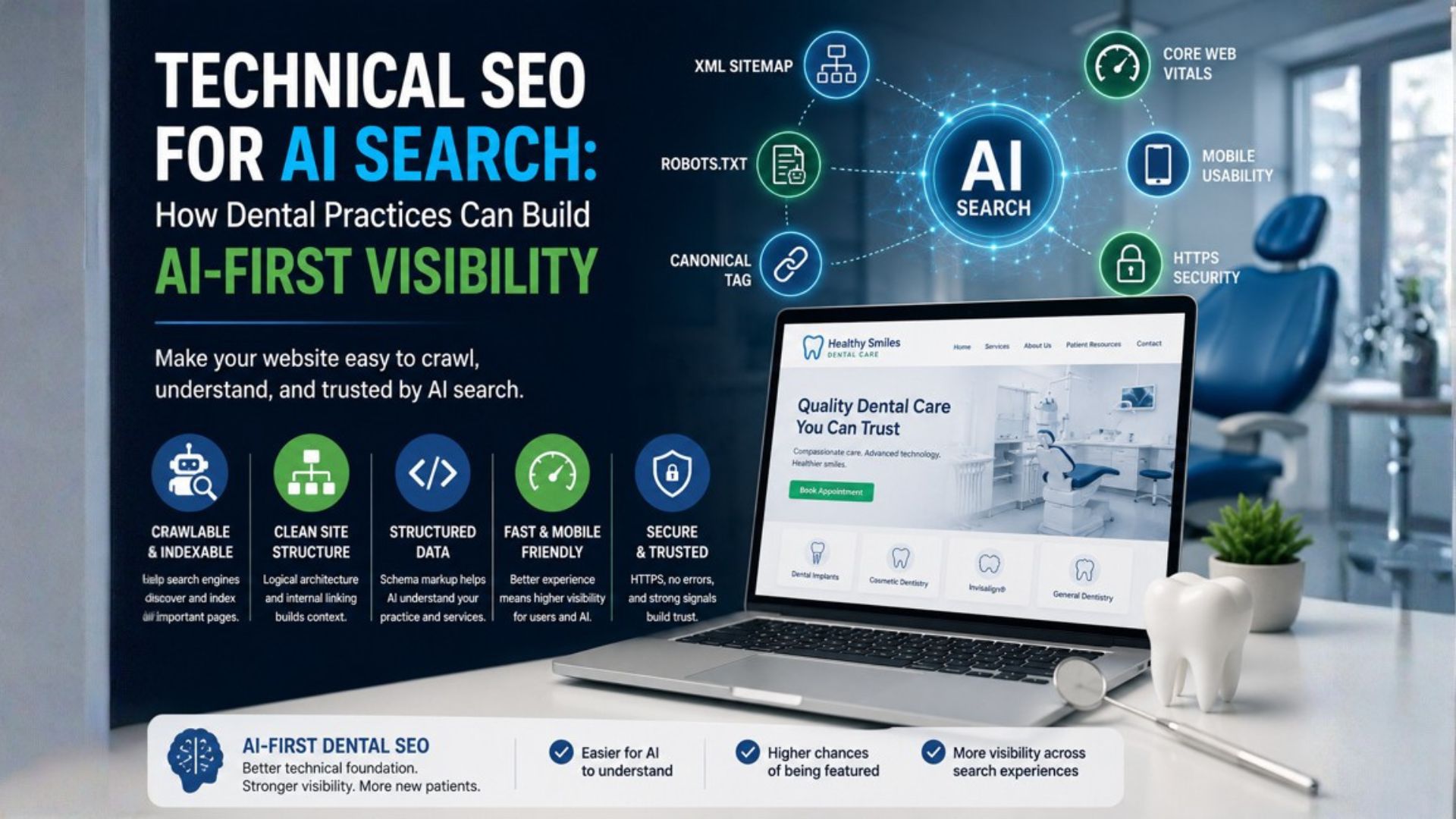
AI-powered search is changing how patients discover dental practices. Instead of simply scanning a list of blue links, patients can now receive AI-generated answers, comparisons, recommendations, and follow-up information directly within search experiences.
For dental practices, this creates a new SEO priority: AI-first visibility.
But AI-first visibility does not mean abandoning traditional SEO or relying on shortcuts designed specifically for AI. Google confirms that its generative AI search features continue to rely on foundational SEO and Search systems to discover and retrieve web content.
That makes technical SEO more important than ever.
What Does AI-First Technical SEO Mean?
AI-first technical SEO is about making your website easy for search engines and AI-powered systems to discover, crawl, render, index, interpret, and retrieve.
For a dental website, this means ensuring that important information about your practice, services, locations, expertise, and patient resources can be accessed and understood without unnecessary technical barriers.
The goal isn’t to “trick” AI into mentioning your practice. It’s to build a technically sound website that provides reliable information that search systems can confidently process.
1. Make Your Website Crawlable and Indexable
Before your dental practice can appear in search or AI-generated results, search systems need to be able to access your pages.
Start with the fundamentals:
- Check your robots.txt file
- Maintain an accurate XML sitemap
- Fix broken links
- Resolve 404 errors
- Review redirects
- Check canonical tags
- Remove accidental noindex directives
- Monitor indexing in Google Search Console
Google states that pages generally need to be indexed and eligible to appear in Google Search to be eligible for supporting links in AI Overviews or AI Mode.
A great dental implant page cannot contribute to AI visibility if search engines cannot properly access or index it.
2. Build a Clear Website Architecture
AI systems need context.
A well-organized website helps establish relationships between your practice, treatments, locations, and educational content.
For example, your website structure might connect:
Dental Practice → Dental Services → Dental Implants → Implant FAQs → Implant Aftercare
Use descriptive URLs, logical navigation, breadcrumbs, and internal links to reinforce these relationships.
A blog about dental implant recovery, for example, should naturally link to the relevant dental implant service page. This helps users and search systems understand how your content fits together.
3. Use Structured Data to Clarify Your Dental Practice
Schema markup can provide additional context about the entities and information represented on your website.
For dental practices, appropriate structured data can help clarify information such as:
- Practice name
- Address
- Phone number
- Business type
- Services
- Locations
- Opening hours
- Organization information
However, schema is not an AI ranking shortcut. Google specifically cautions against chasing “GEO hacks.” The focus should be on providing accurate, useful information and using structured data to describe content that actually exists on the page.
4. Make Important Content Accessible
Modern websites often rely on JavaScript for menus, appointment forms, animations, and interactive features.
That’s not inherently a problem, but critical information shouldn’t be hidden behind technical barriers.
Your key dental services, location information, navigation, internal links, and important patient information should be accessible to crawlers and users.
This makes JavaScript SEO, rendering, HTML structure, and accessibility important considerations within an AI-ready technical SEO strategy.
5. Strengthen Your Entity Signals
AI search increasingly needs to understand who your business is, what it offers, and where it operates.
Make sure your website consistently communicates your:
- Practice name
- Physical location
- Services
- Dentists and professionals
- Areas served
- Contact information
- Credentials and expertise
Keep these details consistent across your website, Google Business Profile, relevant directories, and other trusted online sources.
For a dental practice serving Toronto, for example, your website should make the relationship between your practice, Toronto, your specific services, and your patient audience clear.
6. Create Content That Answers Complete Patient Questions
Technical SEO gets your content accessible. Useful content gives AI systems a reason to retrieve it.
Instead of creating separate pages for every keyword variation, build comprehensive resources around real patient needs.
For example, a dental implant resource could answer:
- Who is a candidate for dental implants?
- How does the procedure work?
- How long does recovery take?
- How should implants be maintained?
- What alternatives are available?
- What questions should patients ask their dentist?
Google recommends focusing on helpful, reliable, people-first content rather than creating large quantities of pages simply to target variations of queries.
7. Don’t Ignore Website Performance
An AI-ready website still needs to provide a good experience for real patients.
Review Core Web Vitals, page speed, mobile usability, image optimization, server performance, and unnecessary scripts.
A technically efficient website helps both search systems and patients navigate your content more effectively.
Build an AI-First Dental SEO Foundation
AI search doesn’t replace technical SEO, it makes the fundamentals more important.
For dental practices, an AI-first approach should prioritize:
Crawlability → Indexability → Technical clarity → Entity understanding → Content accessibility → Patient-focused content → Authority
This creates a foundation for visibility across traditional search and emerging AI-powered search experiences.
Final Thoughts
The future of dental search isn’t simply about ranking number one for a keyword. It’s about making your practice discoverable, understandable, and trustworthy across increasingly AI-driven search experiences.
For dental practices across Toronto, Burlington, Hamilton, Mississauga, and communities throughout Canada, technical SEO should be an ongoing part of your digital marketing strategy.
At Dental Marketer, we combine technical SEO with content, local SEO, and broader dental marketing strategies to help practices build a stronger digital presence.





