
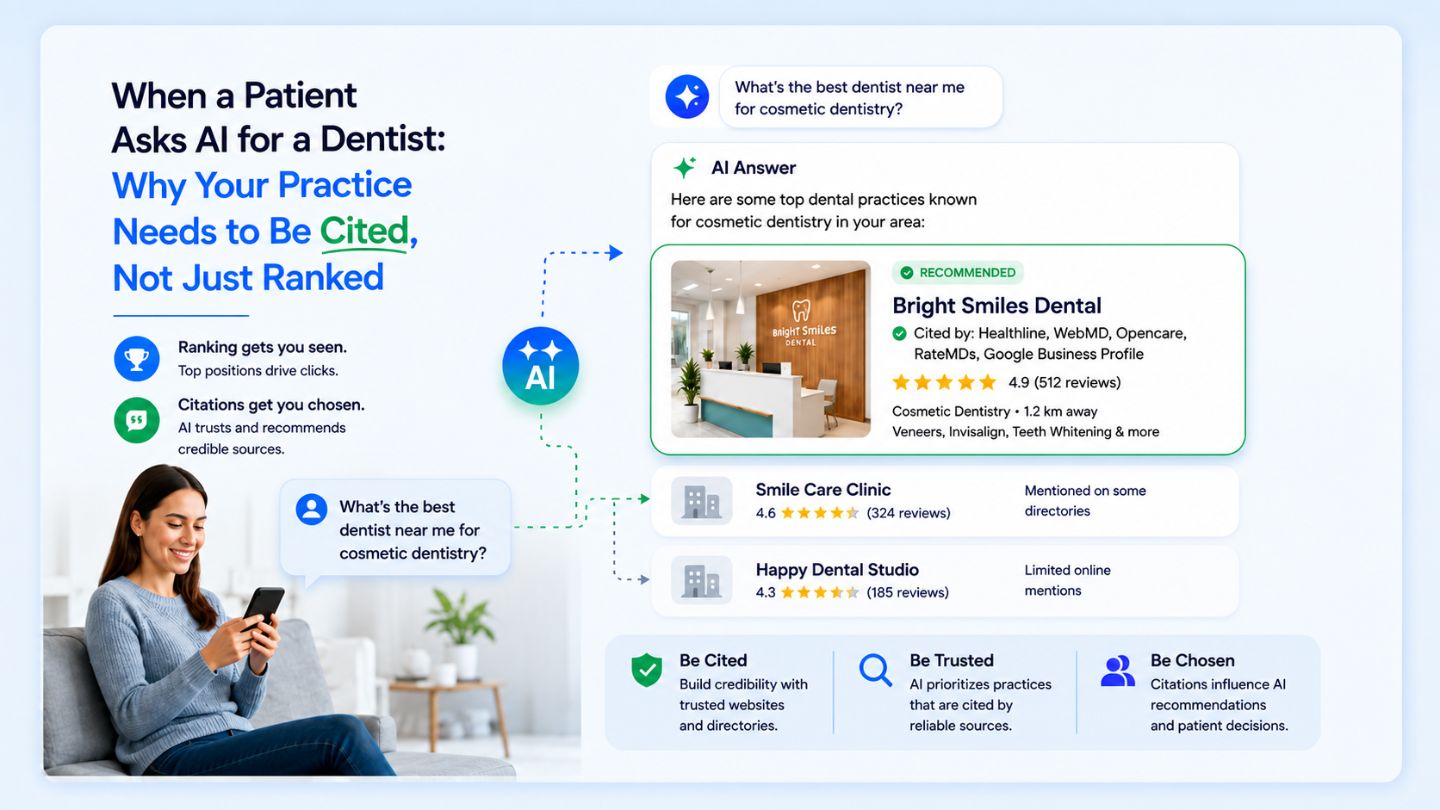
A patient in your city opens an app, types “best dentist near me for a chipped tooth,” and gets a written answer back in seconds. No list of ten blue links to scroll. No map pack to compare. Just a confident recommendation, pulled from a handful of sources the system decided to trust. The question for every practice owner in 2026 is simple. When that answer gets written, is your practice in it?
For years, dental marketing success meant ranking on the first page of search and showing up in the local map results. That still matters. But a fast-growing share of patients now get their answer directly from an AI tool before they ever click a single website. If your marketing reporting stops at keyword rankings, you are only seeing part of how patients are finding you, and missing the part that is growing fastest.
This guide breaks down what AI citations are, why they matter for filling your schedule, and what your practice can do to start showing up in the answers patients are already reading.
What an AI Citation Means for a Dental Practice
An AI citation happens when an answer engine pulls information from a website to build the response it shows a patient. Sometimes it names the practice directly. Sometimes it simply uses the information without the name. Either way, that source shaped the recommendation the patient saw.
This works differently from how dental SEO has always worked. The familiar path was that you ranked, the patient clicked, they landed on your site, and they booked. The new path is that a patient asks a question, the system reads trusted sources, and it hands back an answer that may name your practice as the place to call. The patient might book straight from that answer without ever visiting your homepage first.
For a practice, being the cited source is the new version of being the top result.
Read More: How To Build Brand Visibility in AI Search
Why This Matters When You Are Trying to Fill the Schedule
A few reasons make this worth your attention now rather than later.
The first is trust. When a patient asks where to go and an AI tool names your practice, that recommendation carries weight. It feels less like an ad and more like an answer, which is exactly how patients want to choose a dentist.
The second is visibility even without a click. A patient researching “Invisalign vs braces for adults” may never visit your site, but if your practice is named as a local provider in that answer, your name lands in front of them at the exact moment they are deciding.
The third is timing. Most dental practices have done nothing to adapt to this shift. The ones that move early build a presence in these answers that competitors will struggle to displace later. In a local market with a handful of practices competing for the same patients, being the one the AI consistently names is a real advantage.
Traditional Dental SEO and AI Citations Are Not the Same Job
It helps to see clearly how the two differ, because they are measured in different ways.
Traditional dental SEO is about ranking in search and the local map results, and you judge it by positions, clicks, and calls. The work centers on local keywords, reviews, links, and a technically healthy website. The patient behavior you are aiming for is a click that turns into a booking.
Citation-focused work is about being referenced inside the answer itself, and you judge it by how often your practice shows up and how it is described. The work centers on clear information about who you are and where you are, strong authority signals, and content that answers patient questions directly. The outcome is being named as the recommended option.
The winning approach for a growing practice is not choosing one over the other. It is doing both, so you capture patients whether they click through the old way or read an answer the new way.
Read More: What Is Google AI Mode? (+ How to Optimize for It in 2026)
Four Layers of Visibility for a Modern Practice
Think of your online presence as four connected layers rather than separate projects.
The foundation: local dental SEO
This is still the bedrock. Without a fast, technically sound website, accurate local listings, strong reviews, and content that covers your services, your practice will not even be a candidate for AI to cite. Keep the fundamentals strong: site speed, mobile experience, consistent name, address, and phone number across the web, healthy review velocity, and clear pages for each service you offer.
Answering the questions patients actually ask
The next layer is structuring your content to answer real patient questions plainly. Use question-style headings like “How much does a dental crown cost in [your city]” and place a clear, direct answer right underneath, then expand below it. The clearer your direct answer, the easier it is for a system to lift it into a response.
Becoming the source worth citing
This layer is about being the obvious thing to reference for your area and your services. Cover your treatments in real depth rather than thin one-paragraph pages, name your city and neighbourhoods clearly, and make your practice the most complete local resource on the procedures you want to attract patients for.
Writing for how these systems read
The final layer is about being easy to parse and trust. Use clean headings, write in plain language a nervous patient could follow, state facts that can be verified, keep your dentist and team bios consistent and visible, and use structured data so systems understand exactly what your practice is, where it is, and what it offers.
How to See Whether Your Practice Is Being Cited
Tracking this is still new, so a mix of manual checks and emerging tools works best.
Start by reviewing your search performance reports for any breakout of impressions tied to AI answer panels, where that data is shown. This hints at which patient questions are triggering answers connected to your site.
Next, do regular manual checks the way a patient would. Search the questions your patients ask, such as “emergency dentist in [your city]” or “teeth whitening near me,” across the major answer engines, and note every time your practice name, website, or content shows up. A simple spreadsheet listing the question, the platform, the type of mention, and the date is enough to start spotting where you appear and where a competitor is named instead.
Layer in visibility monitoring tools as they mature, since several now track how often a brand is named inside AI answers and can save you the manual work.
Finally, set up brand alerts that pair your practice name with phrases that show up around recommendations, so you catch mentions you would otherwise never see.
Content That Earns Your Practice a Mention
Getting cited is not luck. It comes from deliberate choices about what you publish.
Build real depth on your services. Answer engines lean on sources that cover a topic thoroughly. A strong main page on a treatment, supported by pages answering the common follow-up questions about cost, recovery, and candidacy, signals that your practice is a genuine authority on that procedure.
Lead with the answer. When a patient asks how long a root canal takes or whether it hurts, put the honest, direct answer at the top, then explain. If the clear answer is buried, a competitor who states it plainly gets referenced instead.
Show real experience. Your dentists’ credentials, years in practice, and genuine patient outcomes are exactly the kind of signals these systems favour. Make your team’s expertise visible rather than hidden on an about page no one updates.
Be specific about location. Name your city, your neighbourhoods, and the areas you serve clearly throughout your site. Local specificity is how a system decides your practice is the right one to name for a patient nearby.
Use structured data properly. Marking up your practice as a local business, your team as people, your services, and your patient questions helps systems confirm the facts and pull the right details into an answer.
A Technical Checklist for AI Readiness
Work through this to make sure nothing is quietly keeping your practice out of these answers.
- Confirm your site is crawlable and that automated readers can reach your pages.
- Keep load times fast, since slow sites get deprioritized.
- Make sure your mobile experience is strong, because that is usually what gets read.
- Use clean, descriptive URLs for your service and location pages.
- Implement canonical tags correctly so duplicate pages do not cause confusion.
- Review your crawler permissions so you are not accidentally blocking the readers building these answers.
- Run your whole site over a secure connection.
- Validate your structured data with a testing tool.
- Build internal links that connect your service and location pages clearly.
- Keep your page experience metrics within healthy thresholds.
New Numbers Worth Watching Alongside Calls and Bookings
Your reporting should grow beyond rankings and click counts. Consider tracking these as well.
Track how often your practice is named across AI answers for your key patient questions. Compare that against how often local competitors are named, which gives you a sense of your share of the conversation in your market. Watch how your practice is described when it does appear, since being named is only good if the framing is positive. Estimate the awareness value of showing up in answers that do not produce an immediate click. And tag the referral traffic from answer engines that do send patients through, so you can connect it to actual bookings.
Mistakes That Quietly Keep Your Practice Out of AI Answers
A few common errors do real damage.
Accidentally blocking the automated readers that build these answers is the most self-defeating, so check your crawler permissions first. Thin service pages get ignored, so each treatment deserves a page with genuine substance. Missing structured data makes your practice harder to understand, so put it in place. Weak or hidden credentials hurt, since these systems favour demonstrated expertise, so make your dentists’ experience visible. Stale information loses ground to fresher sources, so keep your hours, services, and key pages current. And relying only on stuffing local keywords backfires, because depth and clarity matter far more than repetition.
The Bottom Line
Rankings and the map pack still bring patients through your door, and they are not going anywhere. But more patients are now getting their answer straight from an AI tool before they ever compare websites. The practices that stay visible will be the ones that earn trust from both traditional search and the answer engines patients are starting to rely on. Start checking whether your practice shows up in those answers, build content worth citing, and treat being named as a real goal. The groundwork you lay now decides whether you are the practice the AI recommends, or the one it leaves out. Dental Marketer specializes in creating high-converting dental website design that combines design excellence with strategic marketing insight, helping practices turn online visitors into loyal patients.
Frequently Asked Questions
What is an AI citation for a dental practice?
It is any time an answer engine references your practice, your website, or your content while answering a patient’s question, such as naming you as a local provider for a treatment.
How do I know if my practice shows up in AI answers?
Search the questions your patients ask across the major answer engines and note where your practice appears, review your search performance reports for AI answer impressions, use visibility monitoring tools as they become available, and set up brand alerts for your practice name.
Does traditional dental SEO still matter in 2026?
Yes, completely. It is the foundation. Without a healthy website, strong local listings, good reviews, and quality content, AI tools are unlikely to cite your practice. The strongest approach pairs solid local SEO with content built to be cited.
How is this different from regular SEO for dentists?
Regular dental SEO aims to rank you in search and the local map results. Citation-focused work aims to get your practice named inside the AI-generated answer itself, with more weight on clear local information, demonstrated expertise, and content that answers patient questions directly.
What structured data matters most for a dental practice?
Local business markup, person markup for your dentists, service markup for your treatments, and FAQ markup for patient questions are the most valuable, because they help systems confirm who you are, where you are, and what you offer.





