
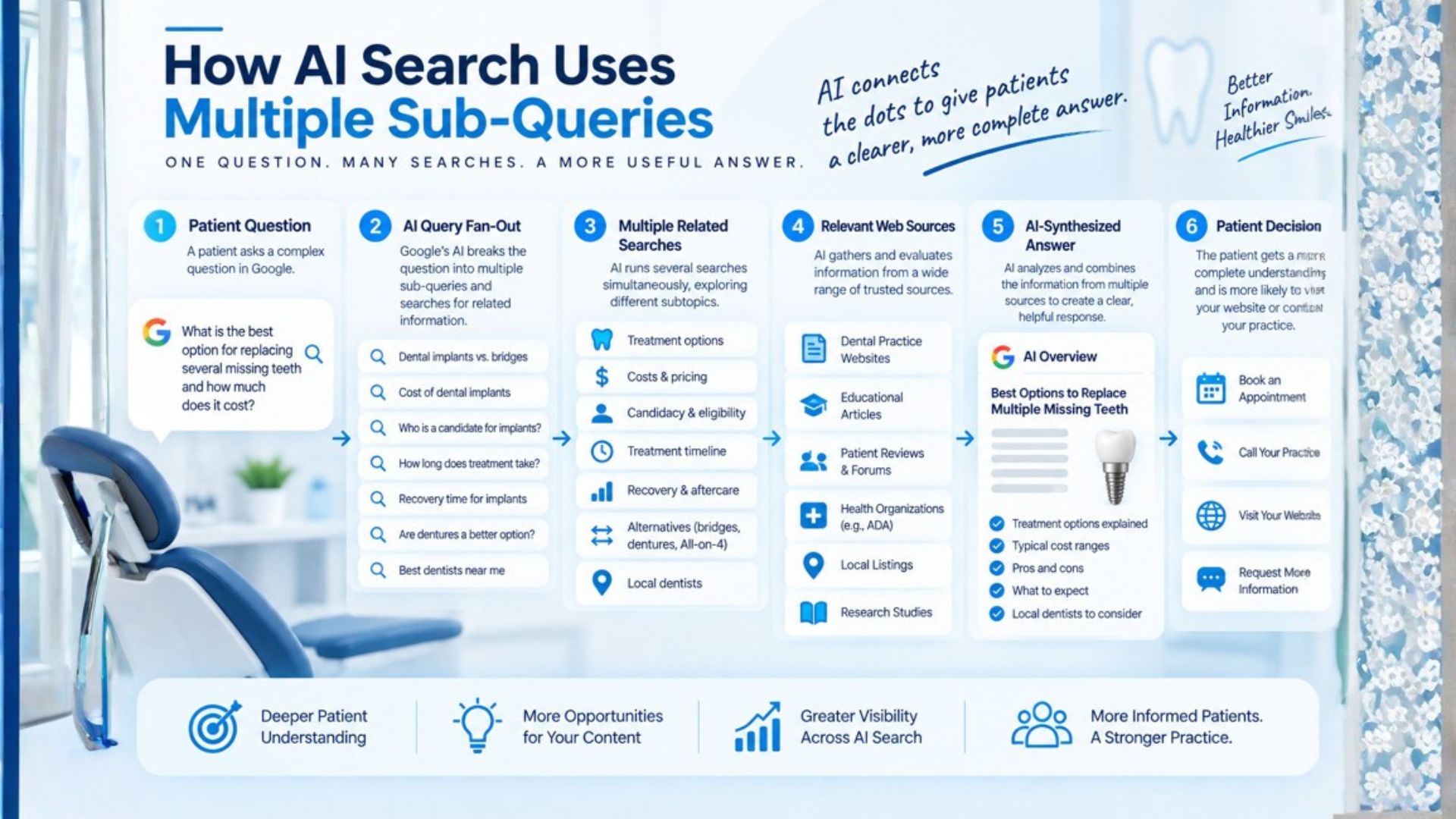
When a patient asks Google a complicated question, the search process is becoming very different from the traditional “type a keyword, receive a list of webpages” experience.
Google’s AI Mode is designed to handle longer, more complex and multi-part questions. Behind the scenes, Google says it can use query fan-out to break a question into multiple subtopics and run numerous searches simultaneously.
The system can then use information gathered from those searches to build a response that addresses different parts of the patient’s question.
For dental practices, this creates a new reason to think carefully about the depth and structure of website content.
What Happens When a Patient Asks a Complex Question?
Imagine someone searches:
“What is the best option for replacing several missing teeth, and how much does it cost?”
That sounds like one question.
But answering it properly requires several pieces of information.
An AI search system may need to consider topics such as:
- Dental implants
- Implant-supported bridges
- Traditional bridges
- Dentures
- Treatment costs
- Patient candidacy
- Treatment timelines
- Recovery
- Long-term maintenance
- Local treatment availability
Google describes query fan-out as a way for AI Mode to break a complex question into subtopics and issue multiple searches, allowing Search to explore information more deeply.
The patient ultimately sees a single conversational response.
But the information behind that response can come from multiple searches and sources.
Why Dental Websites Need Greater Content Depth
This is why simply having a page that says:
“We offer dental implants.”
isn’t enough.
A strong implant page should explain the treatment in a way that helps a real patient make an informed decision.
For example:
How Much Do Dental Implants Cost?
Explain the factors that can affect treatment costs.
Who Is a Candidate for Dental Implants?
Explain the factors a dentist evaluates.
How Long Does Implant Treatment Take?
Explain that treatment timelines vary and what stages may be involved.
Are Dental Implants Better Than Bridges?
Explain the differences rather than simply promoting one treatment.
This approach gives the page meaningful topical depth.
Build Around Patient Questions, Not Just Keywords
One of the biggest mistakes in AI-era SEO is assuming that every opportunity will appear inside a keyword research tool.
Patients don’t always search using neat SEO phrases.
They ask questions.
And AI search is designed to handle increasingly complex questions.
Google’s current guidance specifically notes that people are using AI search for longer, more specific questions and recommends focusing on unique, valuable content that genuinely satisfies users.
For a dental practice, that means your best content ideas may come directly from:
- Questions patients ask during consultations
- Questions receptionists answer repeatedly
- Questions appearing in emails and phone calls
- Treatment objections
- Cost concerns
- Recovery concerns
- Questions about alternatives
These are real examples of search intent.
How Should Dental Practices Optimize for AI Search?
There isn’t a secret AI-specific markup or formula that guarantees inclusion.
Google’s current documentation says pages appearing in AI features still need to meet normal Search technical requirements, including being crawlable, indexable, and eligible to appear with a snippet. Google also recommends helpful, reliable, people-first content and says structured data should accurately match visible page content.
For dental practices, that means focusing on five fundamentals:
- Answer the question directly.
Don’t bury the answer underneath several paragraphs of introduction.
- Cover related questions.
Anticipate what patients will ask next.
- Use clear headings.
Make individual questions easy to identify and understand.
- Provide specific information.
Where appropriate, discuss treatment timelines, costs or cost factors, candidacy, alternatives, and what patients should expect.
- Connect related pages.
Link service pages to supporting articles and relevant treatments so both patients and search engines can understand the relationship between topics.
The Bigger Opportunity for Dental Practices
AI search doesn’t eliminate the need for dental websites.
It makes useful dental websites more important.
When an AI system needs to understand a complicated treatment question, websites with clear, original, well-organized information have more opportunities to contribute useful information to that research journey.
And when a patient eventually visits your website, the same content serves another purpose: it answers their questions, reduces uncertainty, establishes credibility, and helps them decide whether to contact your practice.
The objective, therefore, isn’t simply to optimize a website for AI.
It’s to build a website that is so useful to the patient that AI search, traditional search, and the patient themselves can all understand its value.





