Artificial intelligence has quickly become part of the modern content marketing workflow. From generating blog outlines to drafting service pages, creating FAQs, and developing SEO ideas, AI can help marketing teams work faster.
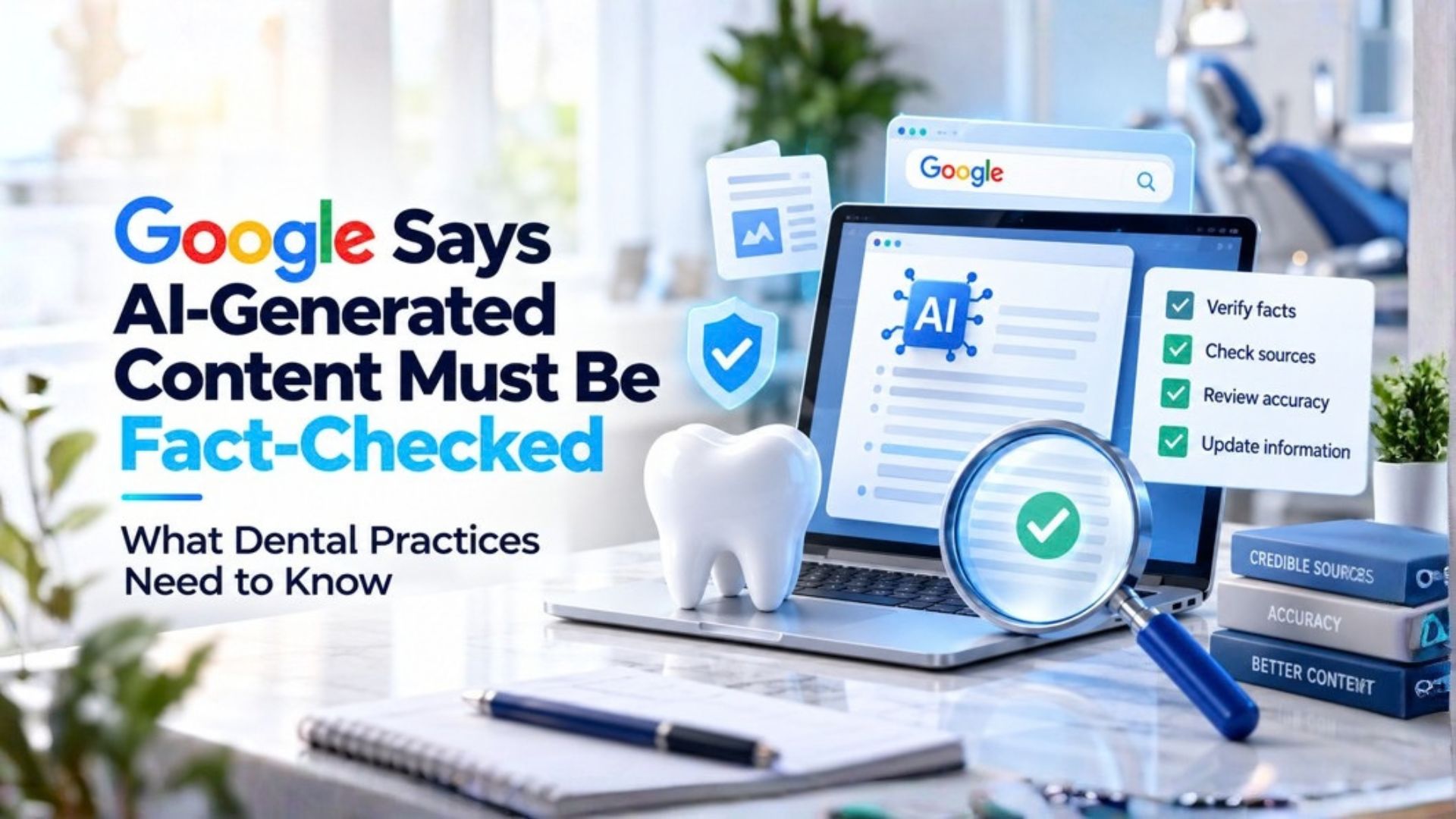
But Google has recently made an important clarification for businesses using AI to publish website content: AI-generated content should be manually reviewed and fact-checked before it goes live.
Google’s updated guidance explains that generative AI does not independently retrieve and verify facts. Instead, AI models predict likely sequences of words based on their training data, which means they can sometimes produce inaccurate or misleading information. Google now describes manual fact-checking and review as critical before AI-generated content is published.
What Does This Mean for Dental Websites?
For dental practices, this guidance is especially relevant.
Healthcare content needs to be accurate, clear, and trustworthy. A seemingly small AI-generated mistake about a dental procedure, treatment timeline, insurance information, recovery expectations, or oral health recommendation can reduce a patient’s confidence in a practice.
That doesn’t mean dental marketers should stop using AI.
Instead, AI should be treated as a content assistance tool rather than the final authority.
AI can help with research, brainstorming, outlines, content organization, and first drafts. The final content should still be reviewed by someone who understands the subject and can verify important claims.
Read More: Importance of Writing High-Quality Content for Dental Websites
AI Content Needs More Than a Grammar Check
A human review shouldn’t simply look for spelling mistakes.
Before publishing an AI-assisted article, marketers should check:
- Are the medical and dental claims accurate?
- Are statistics supported by reliable sources?
- Are treatment descriptions current?
- Does the content reflect the practice’s actual services?
- Are claims about costs, insurance, or treatment outcomes appropriately qualified?
- Does the article provide information that is genuinely useful to patients?
- Does the content contain original insights rather than simply rephrasing existing articles?
Google’s broader people-first guidance encourages content that provides original information, demonstrates expertise, contains accurate information, and gives readers a clear understanding of who created it.
Read More: 11 Timeless SEO Fundamentals AI Can’t Replace
Don’t Forget Your SEO Elements
One of the more important parts of Google’s updated guidance is that the review process isn’t limited to the main article.
Google specifically includes title tags, meta descriptions, structured data, and image alt text among the elements that should be reviewed when AI is used to create them.
For example, an AI-generated meta description might accidentally make an unsupported claim such as “the leading dentist in the city.” A structured-data field could contain incorrect information. Even an image alt tag could describe something that isn’t actually shown.
These details may seem minor, but they are still part of the information presented to search engines and users.
The Better Approach: AI-Assisted, Human-Reviewed Content
The future of SEO content doesn’t have to be human versus AI.
A more practical approach is AI-assisted content with human oversight.
AI can help marketing teams save time and develop content at scale. Human expertise can then provide accuracy, context, originality, brand voice, and real-world experience.
For dental practices, that could mean using AI to develop an initial outline for a blog about dental implants, followed by a human review of treatment information, patient considerations, terminology, and supporting sources.
The goal isn’t simply to publish more content.
The goal is to publish content patients can trust and find genuinely useful.
Google has previously stated that AI-generated content isn’t automatically against its guidelines. The focus remains on quality, helpfulness, originality, and whether content is created primarily to benefit people rather than manipulate search rankings.
For dental marketers, that makes the takeaway straightforward: use AI to improve the workflow, but don’t outsource responsibility for accuracy to AI.
A strong content strategy combines technology with human expertise, and puts the patient’s need for reliable information first.
Read More: Dental Implant Marketing Strategies That Help Practices Attract More High-Value Patients
How Dental Marketer Supports Dental Practices
At Dental Marketer, we combine AI-assisted content with human expertise to create accurate, useful, and patient-focused content for dental practices. From Dental SEO and content strategy to local SEO and Dental Marketing, we help practices build online visibility while keeping quality, accuracy, and patient trust at the center of the strategy.