
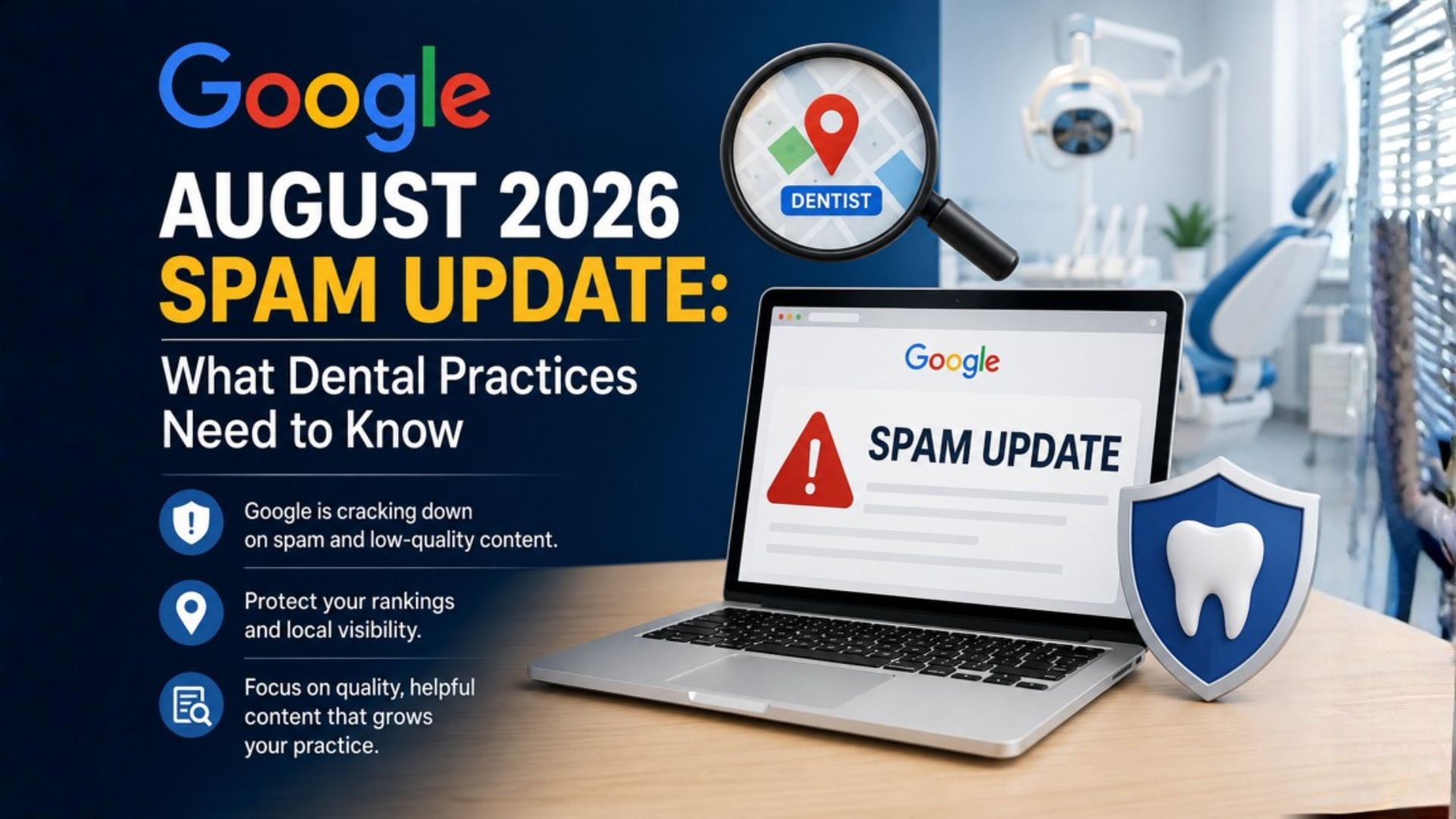
Google has started rolling out its August 2026 Spam Update, the third confirmed spam update of the year. The update began on August 18, 2026, applies globally and across all languages, and Google says the rollout may take a few days to complete.
For dental practices, this is a good time to review your website and SEO strategy. Spam updates are designed to improve Google’s systems for detecting websites that violate its search spam policies. They don’t necessarily mean every dental website will experience a ranking drop.
What Is Google’s August 2026 Spam Update?
Google’s August 2026 Spam Update is a normal spam update, rather than a core update. Google has not announced a new spam policy specifically associated with this rollout. Existing Google Search spam policies remain the key guidelines website owners should review.
The update is also the third spam update of 2026, following the March and June updates.
If your dental website follows Google’s guidelines and focuses on providing useful information to patients, there is no reason to panic.
Why Does This Matter for Dental Websites?
Dental websites often use local SEO strategies involving service pages, location pages, blogs and backlinks.
These strategies can be effective when implemented properly. However, problems can arise when websites create large amounts of repetitive content simply to rank for more keywords.
For example, creating dozens of location pages that contain almost identical content, with only the city or neighbourhood changed, can provide little value to patients.
Google’s spam policies specifically address practices such as scaled content abuse and doorway abuse.
Read More: Avoid These Common SEO Mistakes for Dental Practices
Review Your Location Pages
If you have pages targeting different cities or neighbourhoods, check whether each page provides genuine local value.
A good location page should offer useful information about:
- The practice’s proximity to the area
- Services available to patients
- Directions and accessibility
- Relevant local information
- Unique patient-focused content
Avoid creating pages solely because a keyword has a slightly different location modifier.
Be Careful With Scaled AI Content
AI can be useful for researching topics, organizing ideas and assisting with content creation.
However, producing large quantities of generic content primarily to manipulate search rankings can create SEO risks.
For dental websites, quality matters more than publishing volume.
Instead of producing dozens of similar articles, focus on content that answers real patient questions and demonstrates genuine dental expertise.
For example, an article about dental implants should provide useful information about treatment options, candidacy, procedures, recovery and questions patients may have—not simply repeat the phrase “dental implants” throughout the page.
Don’t Panic Over Short-Term Ranking Changes
Because the August update is still rolling out, it is too early to draw conclusions from a single day’s traffic or ranking data.
If you notice changes, compare your performance over several days and weeks.
Pay particular attention to:
- Google Search Console clicks
- Impressions
- Important keyword rankings
- Organic traffic
- Service-page performance
- Local search visibility
- New patient leads
A ranking fluctuation does not automatically mean your website has been penalized.
What Should Dental Practices Do Now?
1. Check Google Search Console
Compare your website’s performance before and after August 18. Look for significant changes affecting important service or location pages.
2. Review Your Content
Look for thin, duplicated or highly repetitive pages. Pay particular attention to location pages and large batches of recently published content.
3. Review Your SEO Practices
Ask whether your website has recently:
- Created hundreds of similar pages
- Published large amounts of low-value content
- Built questionable backlinks
- Used aggressive keyword optimization
- Created pages primarily for search engines
4. Check for Technical or Security Issues
Unexpected ranking changes aren’t always caused by Google updates. Check for hacked pages, strange URLs, redirects, spam links or other technical problems.
Read More: Technical SEO for AI Search: How Dental Practices Can Build AI-First Visibility
What Does This Mean for Dental SEO?
The August 2026 Spam Update reinforces an important principle: SEO should focus on creating a website that deserves to rank, not simply one that is optimized to rank.
For dental practices, that means focusing on:
- Helpful, patient-focused content
- Strong service pages
- Genuine local relevance
- High-quality backlinks
- Technical SEO
- Accurate business information
- A trustworthy online presence
Rather than asking, “How many pages can we create?”, ask, “Does every page provide something genuinely useful to a potential patient?”
Final Thoughts
Google’s August 2026 Spam Update is still rolling out, so dental practices should avoid making major SEO changes based on short-term fluctuations.
If your website experiences a sustained decline after the rollout, review your Search Console data and audit your website against Google’s existing spam policies before making significant changes.
For dental practices, the safest long-term SEO strategy remains simple: create useful content, build genuine authority, maintain a strong local presence, and avoid tactics designed primarily to manipulate search rankings.
At Dental Marketer, we help dental practices develop sustainable SEO strategies focused on improving online visibility and attracting qualified new patients.





